Leaving WordPress usually costs more in content and people than in software.
That sentence is the whole article, if you’re in a hurry. The rest is for the meeting where someone waves a redesign deck and says the rebuild will be “cleaner” in six months.
I’ve seen enough migrations — and enough almost-migrations — on client estates to know where the money actually goes. The CMS licence was never the expensive line. WordPress is free. The expensive lines are everything wrapped around ten years of pages, editors, URLs and weird little plugins that quietly do one critical job.
What you’re really buying when you “leave”
A mid-size charity, college faculty or political organisation on WordPress is not a brochure site. It has roles, drafts, scheduled posts, custom post types, a media library full of PDFs, and a sitemap Google already trusts. Swap the CMS and you don’t just pick a new theme. You recreate an editorial workplace.
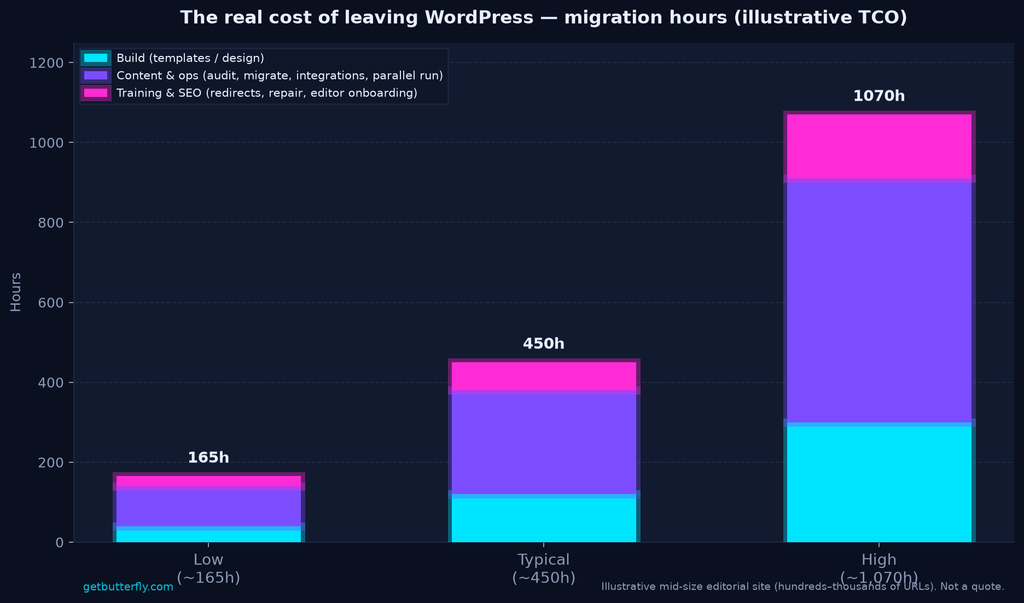
Here’s a rough TCO sketch for a site with a few hundred to a few thousand URLs and a small editorial team. Hours are the useful unit; multiply by your agency rate.
| Cost line | Low (hours) | Typical (hours) | High (hours) | What blows it up |
|---|---|---|---|---|
| Discovery & content audit | 20 | 40 | 80 | Nobody owns the IA; duplicates everywhere |
| Template / design rebuild | 40 | 120 | 300 | “While we’re at it” redesign |
| Content migration & QA | 40 | 100 | 250 | Custom fields, PDFs, embeds, multilingual |
| URL map, redirects, SEO repair | 15 | 40 | 100 | Soft 404s, lost rankings, broken campaigns |
| Editor training & new workflows | 10 | 30 | 60 | Staff used one way of publishing for years |
| Recreating plugins / integrations | 20 | 80 | 200 | CRM, donations, events, SSO, search |
| Parallel run + cutover buffer | 20 | 40 | 80 | Old and new live together longer than planned |
| Rough total | ~165 | ~450 | ~1,070 |
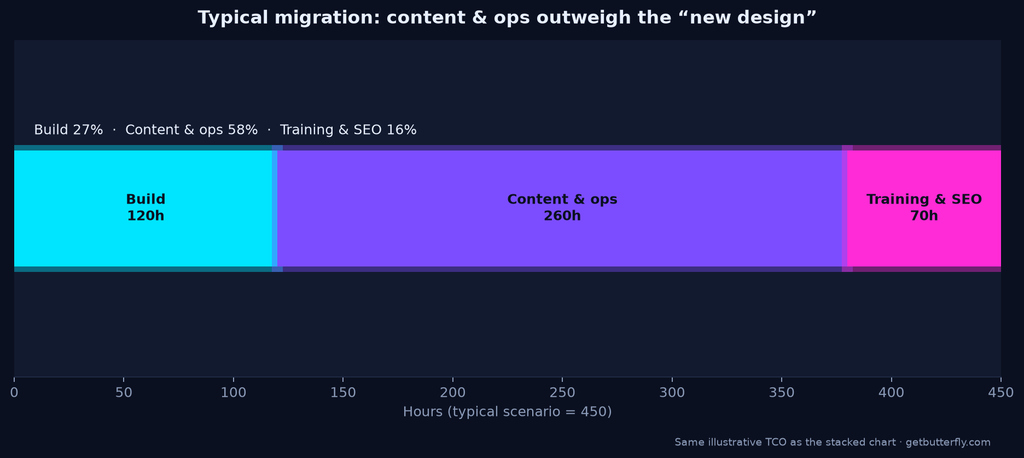
At a blended €80–120/hour, “typical” is already tens of thousands before you count internal staff time, and the high end is a six-figure distraction. None of that includes the opportunity cost of not fixing the site you already have.
The six-month lie
Migrations are sold on a calendar. Reality is overlap. You keep the old site alive because fundraising can’t stop, term dates can’t slip, and press officers still need to publish tomorrow morning. Turned out that a lot of “rewrite the CMS” projects spend half their budget keeping two systems honest at once.
SEO is the silent line item. You can migrate content and still torch rankings with bad redirects, changed URL patterns, or a front-end that ships different titles and canonicals. Recovering that is months of work with no visible “new website” launch party.
When leaving does make sense
Sometimes the rebuild is the right call. Pure ecommerce at scale often belongs on Shopify. A three-page brochure with one non-technical owner is often happier on Squarespace or Webflow. A sprawling permission model that looks like a government intranet may still point some large universities at Drupal. If the current WordPress install is a graveyard of abandoned page builders, unmaintained plugins and no one left who understands wp-config.php, a controlled rebuild can be cheaper than another year of firefighting.
That’s a maintenance and governance problem first. Calling it “WordPress is obsolete” just makes the invoice easier to approve.
What to do instead, if the site is merely tired
Before you budget a new CMS, price the boring work:
- Strip bloat (page builders, 1000-in-1 plugins, leftover page-builder shortcodes)
- Fix hosting, PHP version, cache and CDN
- Lock down roles and updates
- Measure Core Web Vitals on real templates, not the homepage alone
A lean WordPress install with Nginx, PHP 8, a proper cache and Cloudflare is usually faster to improve than it is to replace. (This is also the boring reason I still ship Lighthouse and keep client estates on WordPress instead of chasing greenfield stacks.)
If a vendor can’t put migration hours next to “harden what you have” hours on the same spreadsheet, they’re not helping you decide. They’re helping themselves sell a rebuild.