WordPress is still relevant because most of the web that needs a real CMS already runs on it, and the organisations that keep publishing every day — schools, charities, political parties, big editorial sites — have little reason to rip it out for a rebuild that mainly impresses developers.
I’m writing this for people who already have a WordPress site (or twenty), not for someone shopping for a first homepage. The “WordPress is dead” posts keep coming, usually from people selling something else, and the numbers underneath those posts are a lot less dramatic than the headlines.
The numbers, without the panic
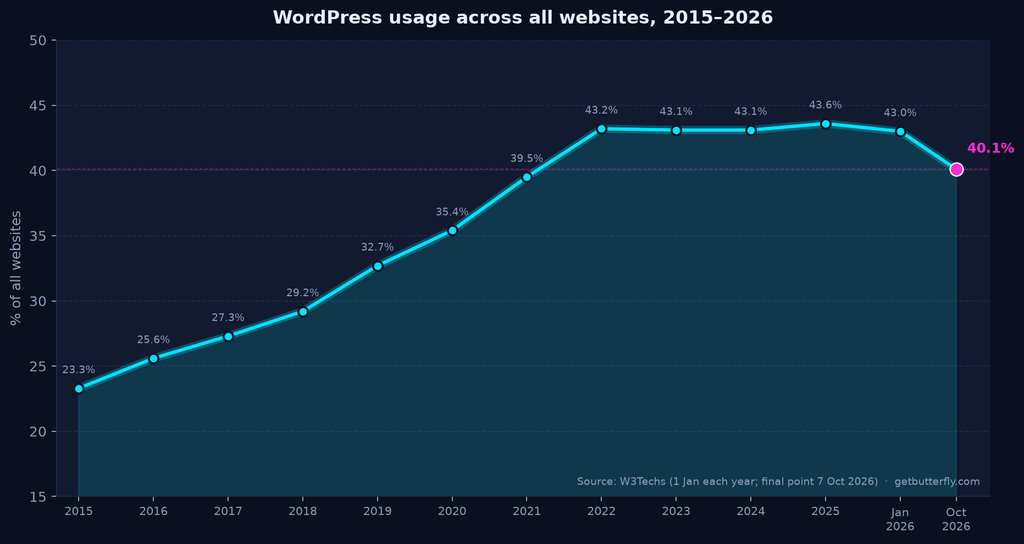
As of October 2026, W3Techs puts WordPress on 40.1% of all websites and 58.6% of sites that use a known CMS. Shopify sits at 5.4% of all sites. Wix at 4.2%. Drupal at 0.6%. That’s not a dying platform; that’s still the default CMS of the open web, even after a few years of slow share loss.
| CMS (Oct 2026, W3Techs) | % of all websites | Share of CMS sites |
|---|---|---|
| WordPress | 40.1% | 58.6% |
| Shopify | 5.4% | 7.8% |
| Wix | 4.2% | 6.1% |
| Squarespace | 2.4% | 3.6% |
| Drupal | 0.6% | 0.9% |
| No CMS detected | 31.6% | — |
The share did fall from a peak around 43% of all sites in 2022–2025. Some of that is SaaS builders eating small brochure sites. Some of it is ecommerce moving to Shopify. Fine. A charity with 800 pages, a university faculty site with a dozen editors, or an Irish estate-agent network with custom fields and a decade of content is not the same problem as a three-page landing page. Those sites didn’t leave, and for the most part they shouldn’t.
What “relevant” actually means for existing sites
For a business already on WordPress, relevance is not market-share bragging. It’s whether the platform still does the job cheaper and safer than a migration.
Editors keep working. Roles, revisions, scheduled publishing, custom post types, taxonomies, media library, multisite — these are boring until you try to recreate them on a static generator or a design tool. Higher-ed surveys keep showing the same pattern: teams stay because extensibility, cost and multisite still matter more than the latest front-end fashion. NASA consolidating a huge public estate onto WordPress VIP (including a headless setup) is a useful reminder that “enterprise” and “WordPress” are not opposites.
The content is the asset. Migration cost is almost never the theme licence. It’s rewriting templates, re-training staff, re-mapping URLs, fixing SEO, and discovering which custom plugins were holding the whole house up. I’ve watched enough “we’ll rebuild in six months” projects turn into eighteen.
You can make it fast. WordPress is not slow. Bloated themes, 1000-in-1 plugins, page builders and bad hosting are slow. A lean theme, few single-purpose plugins, Nginx, PHP 8, a proper cache and Cloudflare will beat a poorly built “modern” stack. (This is also why I keep shipping things like Lighthouse instead of telling people to abandon the CMS.)
Ownership. Open source, no SaaS lock-in for your content database, and a hiring market that still knows PHP and WordPress. For political organisations, charities and public bodies that care about control and procurement, that still counts.
Where WordPress is a weak fit (say it plainly)
I’m not going to pretend it’s perfect. Pure ecommerce at scale often belongs on Shopify. Tiny marketing sites with one non-technical owner are often happier on Squarespace or Webflow. Complex permission matrices that look like a government intranet still push some large universities toward Drupal. If you’re starting a new DTC brand tomorrow, WordPress might not be my first suggestion.
That’s a different sentence from “existing WordPress businesses should migrate.”
So when does staying make sense?
Stay (or invest) when most of these are true:
- You already have years of URLs, content and editorial habits on WordPress
- More than one person publishes, reviews or schedules content
- You need custom content types, not just blog posts and landing pages
- Budget goes further fixing performance and governance than rewriting the CMS
- You care about owning the database and not renting the content forever
Leave the “WordPress is over” pieces for people who need a reason to invoice a greenfield rebuild. For legacy platforms and big editorial sites, the relevant question is still simpler: does it publish, can we secure it, and can we keep it fast? On a maintained install, the answer is usually yes.