WordPress is losing small marketing sites and some ecommerce — not university faculties and charity publishing desks.
W3Techs still has WordPress on 40.1% of all websites as of 7 October 2026 (58.6% of sites with a known CMS). That is down from a plateau around 43% through 2022–early 2026. The doom posts treat that dip as a funeral. The useful question is which kinds of sites moved, because the web is not one market.
The line everyone quotes
WordPress usage across all websites (W3Techs, 1 January each year, plus the October 2026 point):
| Year | WordPress % of all sites |
|---|---|
| 2015 | 23.3% |
| 2016 | 25.6% |
| 2017 | 27.3% |
| 2018 | 29.2% |
| 2019 | 32.7% |
| 2020 | 35.4% |
| 2021 | 39.5% |
| 2022 | 43.2% |
| 2023 | 43.1% |
| 2024 | 43.1% |
| 2025 | 43.6% |
| Jan 2026 | 43.0% |
| Oct 2026 | 40.1% |
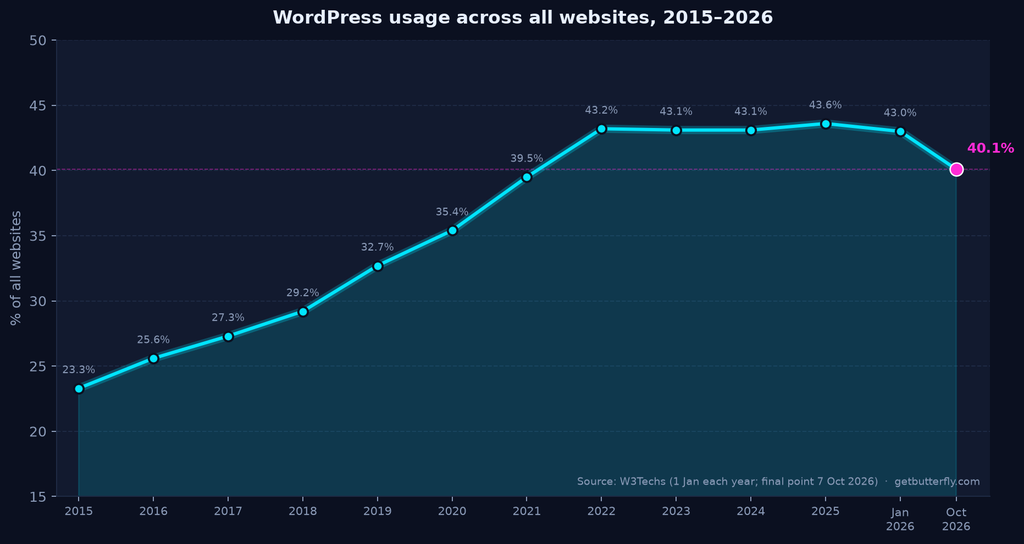
Growth was steep for a decade. Then it flattened. Then it slipped a few points while Shopify, Wix and Squarespace kept climbing from a much smaller base. That pattern looks less like “enterprises fleeing WordPress” and more like “new small sites never starting on WordPress.”
A better way to read the decline
| Site type | Typical move (if any) | Why | Still on WordPress? |
|---|---|---|---|
| 1–5 page brochure / local business | Wix, Squarespace, host builders | One owner, no editorial workflow | Often never started on WP |
| DTC / catalogue ecommerce | Shopify | Checkout, apps, less PHP ops | Many still on Woo; big pure-play shops leave |
| Marketing microsites | Webflow, Framer | Design control, short life | Campaign sites, not the mothership |
| University / college publishing | Stay, or Drupal at the very top end | Multisite, roles, cost, accessibility | Mostly yes at mid-size; Drupal still strong in prestige estates |
| Charities & NGOs | Stay (small/mid); Drupal/Sitecore at huge | Editors + donations + PDFs | WP dominates smaller charities; top-50 UK mix is more Drupal |
| Political / institutional editorial | Stay or bespoke | Control of content, procurement, many authors | Rarely a Wix story |
| News / publishing desks | Stay (often VIP / headless hybrids) | Speed of publishing, CMS habits | Enterprise WordPress surveys still skew media-heavy |
So when global share dips, a large slice of the “loss” is the long tail of tiny sites choosing a SaaS builder on day one. Another slice is commerce consolidating on Shopify. Neither of those is your 800-page charity knowledge base or your faculty CMS with twelve editors and a decade of PDFs.
Who is still choosing WordPress on purpose
Higher-ed research keeps repeating the same reasons: extensibility, cost, multisite, plugins, editing experience. Satisfaction is not universal — the block editor and performance still get complaints — but a minority say they’d switch if money were free. Enterprise WordPress surveys still show publishing/media as a huge share of large installs, with education and non-profit as steady sectors, and more orgs running WordPress as the primary CMS rather than a side blog.
Large public estates have even consolidated onto WordPress (NASA’s public web programme is the loud example: open source, Gutenberg for non-tech staff, VIP hosting, headless where needed). That is the opposite of the “everyone is leaving” narrative.
What this means if you already run WordPress
Don’t use a three-point drop in global share as a business case for a rewrite. Ask which peer group you’re in. If you’re a one-person brochure, sure, compare builders. If you’re an institution with editorial features, legacy URLs and real publishing volume, your peer group mostly stayed — and the competitors in that peer group are Drupal and expensive DXPs, not the homepage of Wix.
Fix the install you have: fewer plugins, better hosting, clearer roles, measured performance. The market-share chart is interesting. It is not a migration plan.